

Crash reconstruction is split across two very different environments.
One is the desk, where the analysis comes together: the research, the driver behavior studies, the careful work of building an opinion that will hold up under scrutiny. That is what Response was built for, and it is where a reconstruction earns its credibility.
The other is the scene. The measurements, the photographs, the lighting readings, the split-second questions about time and distance — that work happens in the field, often at night, and frequently against a clock.
Both environments matter, and the connection between them is where things get lost. So we asked a simple question: what if some of that analytical power could travel to the scene, so the evidence you collect is shaped by it while you are still standing there?
Rapid Response is our answer.
The Problem With Waiting Until You Get
Crash reconstruction depends heavily on the information you collect in the field.
- Take a photo from the wrong spot, and it might not show what the driver saw.
- Forget a measurement, and you may have to drive all the way back to the scene.
- Scribble a note in a hurry, and a few days later, you might not even remember which photo it goes with.
None of these problems happen because the experts are careless. They stem from a field process spread across too many tools – a camera to document, a notebook to document, and a book to review materials. Each handoff is a chance for something to get mislabeled, lost, or cut off from the context that made it important.
There is also a timing problem. An investigator standing at a scene typically needs an answer immediately. Where was the point of no escape? How far would a vehicle travel during a typical braking maneuver? Was there enough distance for the driver to stop?
Waiting until you are back at your computer to run those numbers means you might leave the scene without knowing what else you should have documented.
By then, the opportunity is gone. You cannot always go back.
We designed Rapid Response to close these gaps. Instead of waiting until you are back at the office, the app lets you run common calculations, capture organized scene data, and pull up driver-behavior information right there, with the evidence still in front of you.
Three Types of Tools in One Place
Rapid Response is organized around three main areas: calculators, scene documentation, and driver behavior.
-
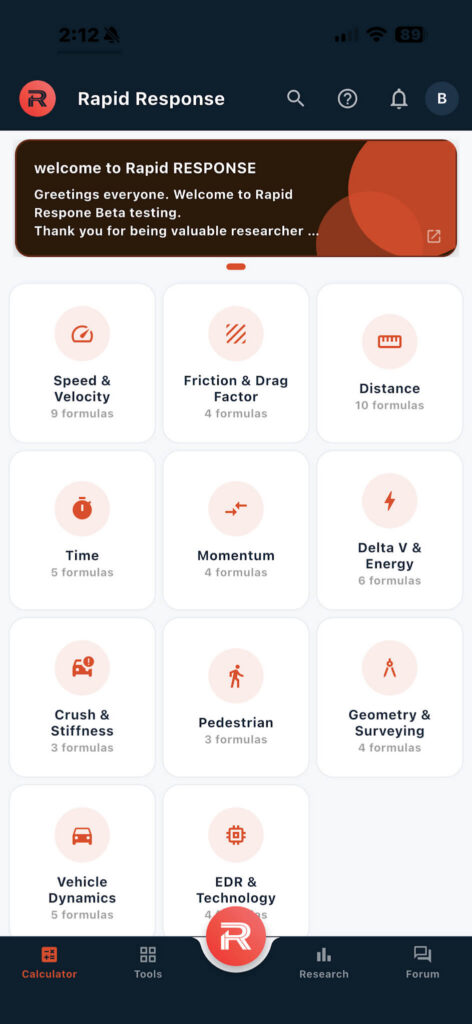
- The calculator section covers speed, time, distance, acceleration, stopping distance, point of no escape, delayed arrival, and other common reconstruction questions.
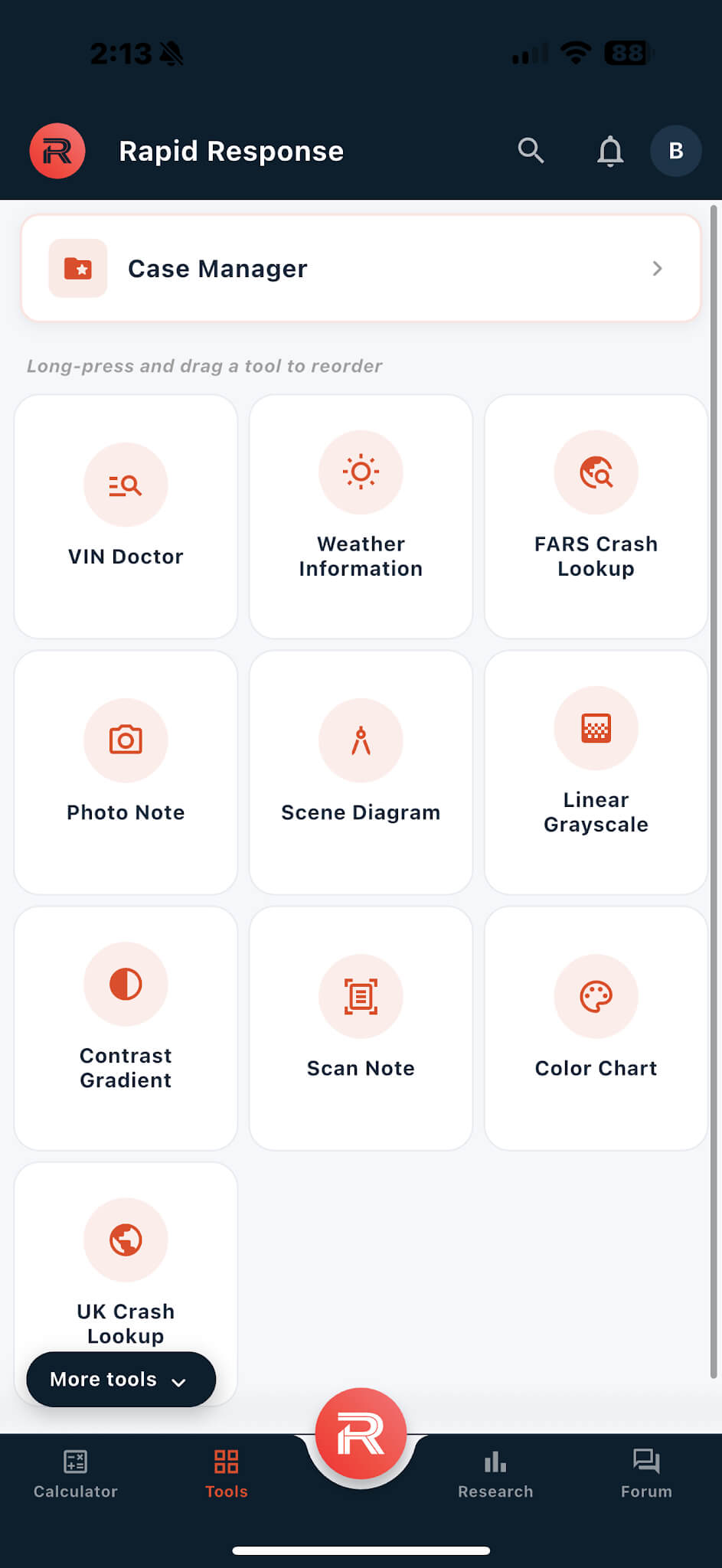
- The scene-documentation section helps experts record photographs, locations, vehicle information, and inspection data.
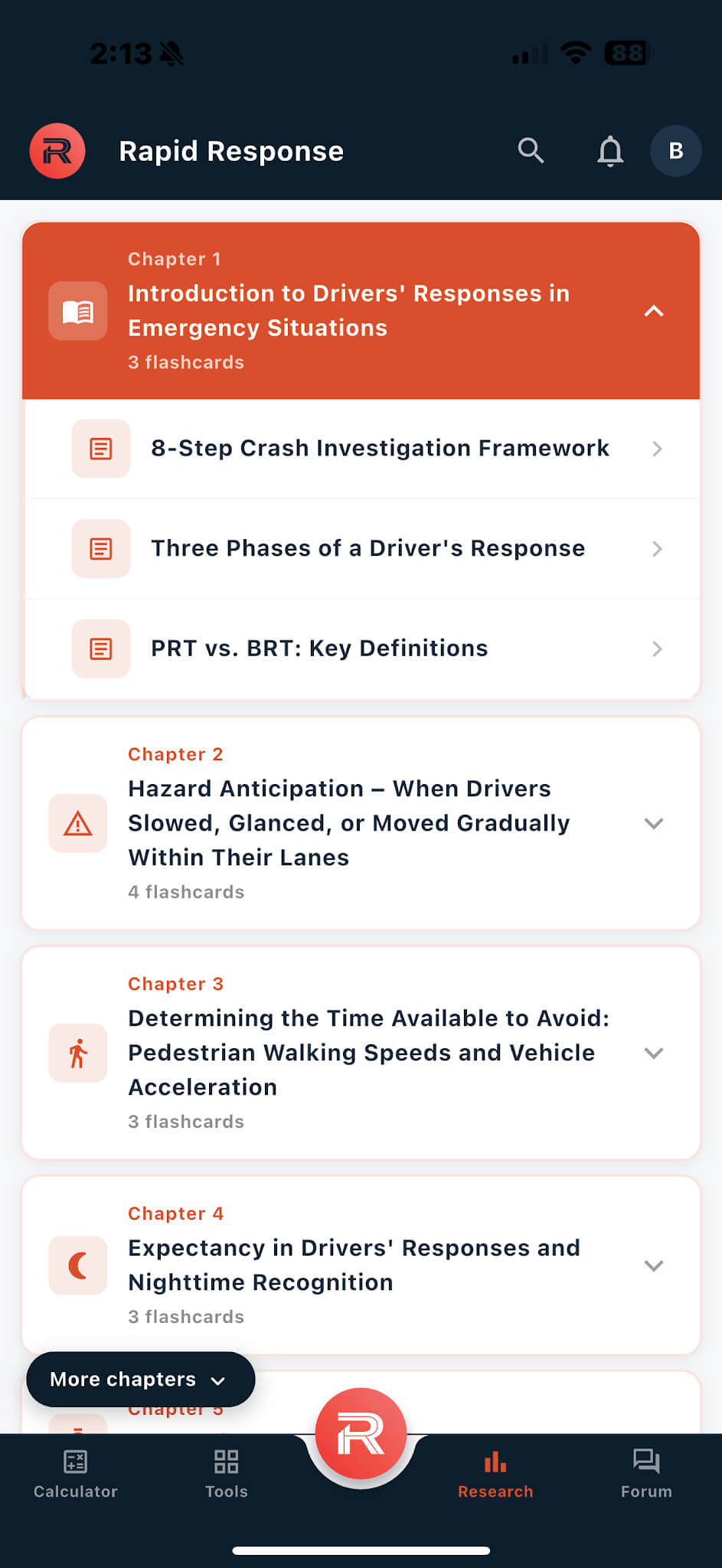
- The driver-behavior section provides quick access to information about response times, speed choices, braking force, and recognition distances.
 |
 |
 |
These three areas work together because no single number ever explains a crash on its own. For instance, a speed calculation does not tell us what the driver could see, or a recognition distance doesn’t tell you whether there was enough road left to brake.
A sound reconstruction, performed with proper crash reconstruction software, connects the physical evidence, the information available to the driver, and the time available for a response.
Calculations at the Roadside
Reconstructionists deal with time-and-distance questions all the time.
A vehicle going about 68 miles per hour covers roughly 100 feet every second. Even a small change in response time can wipe out a big chunk of the distance a driver had to work with.
Standing at a scene, you may want to test a few different possibilities.
- What if the hazard became recognizable one second earlier?
- What if the driver hit the brakes half a second later?
- How far would the vehicle travel during the response phase?
- Would the distance that’s left even allow for a normal braking response?
Rapid Response gives you a quick way to test these relationships while you’re still gathering evidence.
It’s not a substitute for a full reconstruction. A quick field result is just a starting point. But it can show you which facts deserve a closer look and which extra measurements might change your final opinion.
Basically, it beats getting back to the office and discovering that the one measurement you skipped was the one you needed most.
Better Scene Documentation

Photos are one of the most common forms of evidence in crash analysis. They’re also some of the easiest to separate from the details that give them meaning.
Rapid Response includes a photo logger that records GPS information for every image. The location data helps you map where each photo was taken and connect every view back to the scene.
The logger is especially helpful when documenting a driver’s line of sight. A photograph taken near the collision point may show one view, whereas a photograph taken several hundred feet back may show a very different pattern.
The app also supports faster VIN (vehicle identification number) checks by allowing the expert to scan the VIN directly from the vehicle dashboard. A VIN is long, and one incorrect character can return the wrong vehicle information. Scanning reduces manual entry and helps confirm the subject vehicle during the inspection.

Nighttime work adds another wrinkle.
A camera can capture an object that a driver would have struggled to recognize in real time. As the investigator, you know exactly where the object is, and you can stare at the image for as long as you like. The driver had seconds, and no idea where to look.
Rapid Response has tools for documenting contrast gradients during nighttime inspections. You can record scene information right in the app as you study lighting, headlight type, glare, road position, and recognition distance.
Keeping the Driver in the Analysis.
Physics-based reconstruction tools can calculate speed, impact movement, pedestrian throw, and vehicle dynamics. Those numbers matter, but they describe the vehicle rather than the person steering it.
Drivers do not respond the same way in every situation. Response time changes with the information available, the probability of a collision, the type of hazard, visibility, and expectation. Braking force varies. Recognition distance shifts with lighting, contrast, movement, and headlight performance.
Response was built around exactly this — putting the person, not just the vehicle, at the center of the analysis. Rapid Response carries a slice of that into the field, giving experts mobile access to driver behavior information, including typical response times, speed choices, braking behavior, and recognition distances.
That access can change how you run the inspection:
Also, the access can impact how you run the inspection.
- An expert studying a nighttime pedestrian crash may realize that clothing color, movement path, or streetlighting needs better documentation.
- An expert examining a rear-end crash may need to study looming and the speed difference between the vehicles.
Looking at stopping distance, you might need to separate the driver’s response distance from the vehicle’s braking distance.
Having this information in the field pushes the inspection past a single question: “What did the vehicle do?” It adds a second one: “What information did the driver have, and what do drivers usually do in situations like this?”
From Scene to Report
Your work doesn’t end when you leave the scene. Photos, calculations, measurements, VIN data, and observations still have to be organized and tied back to the final analysis.
Rapid Response helps carry all of that into the reporting process. A photo stays linked to its location, a contrast reading stays linked to the nighttime inspection, and a VIN stays linked to the vehicle.
It means less duplicate data entry, and a final opinion that’s easier to explain and review.
More Than a Field Calculator
One of the parts we’re most excited about is the open community forum.
Crash reconstruction covers a lot of specialties. You might have deep experience with vehicle dynamics but less with nighttime recognition. Someone else might know human factors inside and out, but want a second opinion on a scene-documentation method.
The forum gives users a place to ask questions, compare methods, and learn from others in the reconstruction community.
Sometimes the most useful field tool is a calculator. Sometimes it’s research data. And sometimes it’s another reconstructionist who has already worked through the exact question you’re facing.
Rapid Response is also an extension of the full Response platform.
Response helps experts find and apply published research on driver behavior analysis, including perception-response time, braking, steering, speed choice, and nighttime recognition.
Rapid Response brings part of that power to your phone or tablet. The app supports the fieldwork, while the full crash reconstruction software platform supports the deeper research and case analysis that follows.
Together, they connect what you see at the scene with what the studies show about drivers facing similar conditions.
Finally, WHY We Built Rapid Response
The main reason we launched Rapid Response was that reconstructionists needed better tools when they were away from their desks.
For us at the Driver Research Institute (DRI), the goal is to help experts work with better information. A reconstruction gets stronger when the expert collects the right evidence, runs the right calculations, and compares the driver against research involving similar conditions.
Rapid Response helps you start that work at the scene, which is exactly where many of the best questions first show up.
The app doesn’t replace the expert. It just gives them a faster, more organized way to do their job.
If you want to see how Rapid Response fits into your workflow or explore what the full Response platform can do, get in touch with DRI today.